The verb to be for kids: how do you use am, is and are?
Reviewed by Chinh Q. Hoang, PhD, founder, English for Fun ·
Short answer: The verb to be has three present forms: am, is and are. Use am with I, is with he, she, it or one thing, and are with you, we, they or more than one thing. In the past, use was and were: “I am happy”, “It is a cat”, “They were at the park”.
To be is the most common verb in English. It tells who or what something is, what it is like, how someone feels, how old they are and where they are. It is also the most irregular verb: am, is, are, was, were, been and being are all forms of be. Tap each example to hear it.
How do you use am, is and are?
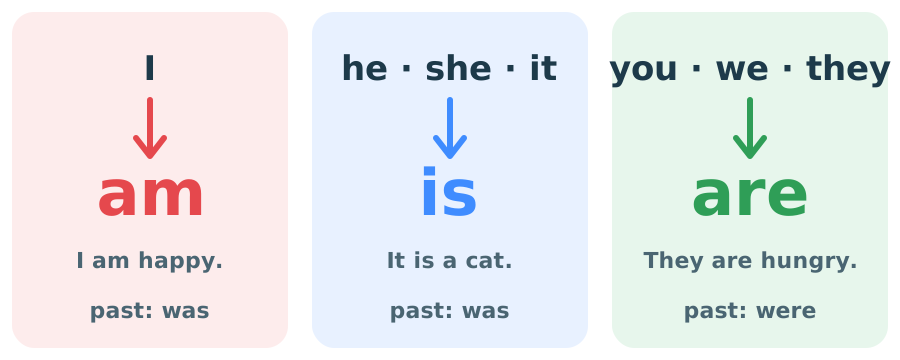
| Subject | Present | Short form | Past | Example |
|---|---|---|---|---|
| I | am | I’m | was | I am six. |
| you | are | you’re | were | You are kind. |
| he, she, it, one thing | is | he’s, she’s, it’s | was | She is happy. The cat is small. |
| we | are | we’re | were | We are at home. |
| they, more than one thing | are | they’re | were | They are hungry. The dogs are big. |
The verb to be in short
- I am, he/she/it is, you/we/they are. In the past: I/he/she/it was, you/we/they were.
- English needs am, is or are before a describing word, a noun or a place: “I am happy”, not “I happy”.
- Questions and negatives do not use do: “Are you hungry?” and “I am not sleepy”.
When do you use the verb to be?
Use be to say what something is, what it is like, how someone feels, how old they are and where they are. Tap to hear each sentence.
How do you make negatives and questions with the verb to be?
- Negative: put not after am, is or are. I am not sleepy. It is not (isn’t) a dog. They are not (aren’t) at school.
- Question: put am, is or are before the subject. Are you hungry? Is it a dog? You do not need do.
- Short answers repeat the verb: Yes, I am. No, it isn’t. Do not shorten a “yes” answer: say “Yes, I am”, not “Yes, I’m”.
Was and were: the verb to be in the past
In the past, I, he, she and it take was; you, we and they take were. Questions and negatives work the same way as in the present: “Were you at school?”, “I was not (wasn’t) tired”.
Common mistakes with the verb to be
- “I happy.” → “I am happy.” English needs am, is or are before a describing word. Many languages leave it out; Vietnamese says “Tôi vui” with no verb, so learners who speak Vietnamese often drop it.
- “I have six.” → “I am six.” Use be for age.
- “I am like milk.” → “I like milk.” Do not put am before an action word. Use am with -ing only for what is happening now: “I am eating.”
- “You is my friend.” → “You are my friend.” You always takes are, even for one person.
- “Do you are hungry?” → “Are you hungry?” Questions with be do not use do.
- “They was late.” → “They were late.” They, we and you take were.
- A gentle fix: do not ask your child to say it again; just say the whole right sentence back, “Yes! You are hungry.”
Be or have?
Children often pick the wrong verb because their own language uses “have” where English uses “be”. Use be for age, feelings and describing; use have for things you own.
| Idea | Right | Common mistake |
|---|---|---|
| age | I am six. | I have six. |
| feeling | I am hungry. I am cold. | I have hungry. I have cold. |
| owning | I have a dog. | I am a dog. |
| what is happening now | I am eating. | I eating. |
Check yourself: the verb to be
- Fill the gap: “She ___ my sister.”
Answer
is. She takes is.
- Fill the gap: “We ___ at the park yesterday.”
Answer
were. We takes were in the past.
- Correct this: “I happy.”
Answer
“I am happy.” English needs am before a describing word.
- Make a question: “You are hungry.”
Answer
“Are you hungry?” Put are before you; no do.
3 games to practice the verb to be at home
- Feelings faces: make a happy, sad or sleepy face and ask “How are you?” Your child answers “I am sleepy!” Then swap.
- What is it? Put a toy in a bag, let your child feel it and guess: “It is a ball!”
- Where is it? Hide a teddy and give clues: “It is under the bed.” Then let your child hide it and tell you where. See in, on and under.
Practice the verb to be
- One rule at a time: I am, you are, it is, he, she, it, we, they + is / are, was and were, negatives with not, yes/no questions and short answers and there is, there are. Each has a short lesson in Grammar Island; the first lesson is free to try, the rest are part of Full Access.
- Sentences with audio: feelings (“I am happy”), color and size sentences (“The ball is red”) and in, on and under (“The cat is on the bed”).
- Build your own sentences with the free sentence builder.
- Đọc bằng tiếng Việt: động từ to be cho người Việt.
Questions
What are the forms of the verb to be?
Be has eight forms: be, am, is, are, was, were, been and being. Children start with am, is and are, then was and were.
Why is “to be” an irregular verb?
Most verbs only add -s, -ed or -ing (play, plays, played). Be changes its whole form: am, is, are in the present and was, were in the past, so it has to be learned word by word.
Is “to be” a linking verb or a helping verb?
Both. In “I am happy” it links the subject to a describing word. In “I am eating” it helps another verb to say what is happening now.
Is it “I am” or “I’m”?
Both are right. I’m is the short form used in speaking and friendly writing. Use the full form in short answers: “Yes, I am.”
Do you say “you is” or “you are” for one person?
“You are”, always. You takes are whether you mean one person or many.
What age can children learn the verb to be?
This page and our games are made for beginners of any age. Young children learn “I am happy” as one chunk long before they learn the rule; the rule can come later.