Things in the house in English for kids
Short answer: This page teaches 17 English words for things in the house, such as door, window, bed, chair, sofa and clock.
Tap a picture to hear the word. Everything on this page can be found and touched at home.
Updated
Reviewed by Chinh Q. Hoang, PhD, founder, English for Fun ·
 Word IslandPlay free
Tap to hear
Keep learning
- Say where things are in the house with in, on and under: “The cat is on the bed”, “The ball is under the chair”.
- Hear the house words in the house and home listening game, or try Find It!.
Good to know
- TV is said letter by letter: “tee-vee”.
- Bathtub is American English; British English often just says bath.
- Key sounds like “kee”; chair starts with “ch”, not “s”.
Play at home
- Stick paper labels on the door, window and chair and read them together.
- Play “Touch something…”: “Touch the sofa! Touch the door!”
- At dinner set the table in English: plate, bowl, spoon.
Practice with Word Island
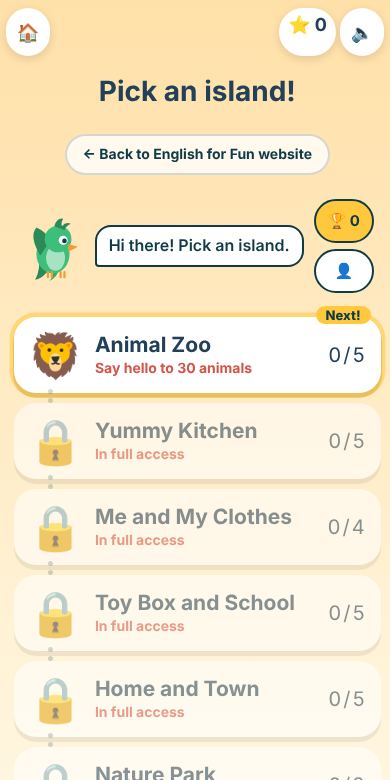
Word Island practices home words, together with vehicles, on Home and Town, which opens with full access. Each pack is a set of short games where the child hears, picks and builds the word, says it out loud, and then meets all the pictures again.
Listening game: hear a word, tap the picture
Hear a word, tap the right picture. Ten questions per round, one topic at a time. Free, no account.
Free printable
Print-ready A4 sheets for “Things in the house in English for kids”: a chart for the wall, cut-out flashcards and a worksheet with two short exercises. Free to print and share with your class.
Practice these words in the Learning Path
The Vocabulary stone has 26 short lessons on this theme, for example “Home · sleep, living room, house”. Each lesson has up to six activities: hear, find, spell, learn the meaning and review the words. Lesson 1 of Vocabulary is free. Open the Vocabulary stone.
Questions
Which room words are in the game?
The game names things, not rooms: house, door, window, bed, chair, sofa, light, clock, mirror, key, bathtub, spoon, plate, bowl, broom, phone and TV.
How can labels help?
Seeing the written word next to the real object every day builds early reading without a lesson.
More topics
Animal names in English for kids: what animal is it?
30 animals from the farm, the zoo and the sea.
Food and fruit words in English for kids
30 words for fruit, vegetables, drinks and treats.
Numbers 1 to 20 in English for kids: how do you say them?
Hear and say every number from one to twenty, with tips for the tricky ones.
The English alphabet for kids: all 26 letters, A to Z
All 26 letters, A to Z, with the name and a picture word for each.